
Uncategorized
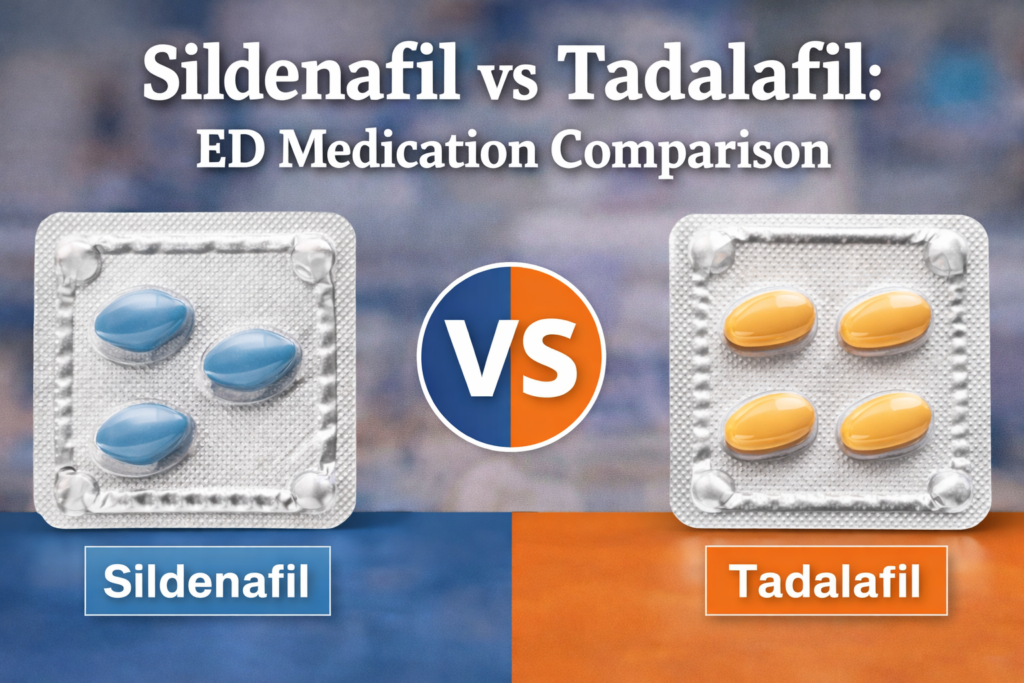
Comparison of Sildenafil vs Tadalafil: ED Medication
Apr
Ever since Viagra (sildenafil) became the first approved PDE5 inhibitor in 1998, and Cialis (tadalafil) introduced its own innovations 5 years later, the question that has been on the minds of millions of men worldwide has been which PDE5 inhibitor should I use?
Sildenafil and tadalafil are in the same drug category, operate by the same fundamental mechanism, and have similar overall effectiveness in clinical trials. But they are very different drugs – different in length, dose adjustability, interactions with food, selectivity, and side effects, as well as practical applicability to various lifestyles and clinical situations.
The decision between them is not an issue of one of them being universally better than the other. It is the question of knowing the significant differences and aligning them with the needs, preferences of individual patients, and clinical situations. This comparative study is thorough and evidence-based to provide you all the information required to have an informed discussion with your physician regarding which is most suitable to you.
At a Glance: Side-by-Side Overview
| Feature | Sildenafil (Viagra) | Tadalafil (Cialis) |
| Drug class | PDE5 inhibitor | PDE5 inhibitor |
| FDA approval (ED) | 1998 | 2003 |
| Generic available | Yes (2017) | Yes (2018) |
| Half-life | 4–5 hours | 17.5 hours |
| Duration of action | 4–6 hours | Up to 36 hours |
| Onset of action | 30–60 minutes | 30–120 minutes |
| Food effect | Significant — take fasted | Minimal — take with or without food |
| Daily dosing option | No (not approved) | Yes (2.5 mg or 5 mg daily) |
| BPH indication | No | Yes (5 mg once daily) |
| PAH indication | Yes (as Revatio, 20 mg) | Yes (as Adcirca, 40 mg) |
| Back pain/myalgia | Rare | More common (~5–7%) |
| Visual side effects | More common | Less common |
| Dyspepsia | Less common | More common |
| Cost (generic) | Very low | Low-moderate |
| PDE6 selectivity concern | Higher | Lower |
| PDE11 inhibition | Minimal | Present (basis for myalgia) |
Mechanism of Action: Different Profiles, same Foundation.
Both sildenafil and tadalafil act by blocking phosphodiesterase type 5 (PDE5) -the enzyme that breaks down cyclic guanosine monophosphate (cGMP) in penile smooth muscle. The two drugs block PDE5 and maintain the levels of cGMP and smooth muscle relaxation in the corpus cavernosum as well as erection in response to sexual stimulation.
Both medications do not act without sexual arousal – they enhance the natural erectile signal, but do not produce it.
Where They Are Different: Selectivity Profile
Although they are both PDE5 inhibitors, they vary in relative selectivity among the phosphodiesterase family of enzymes:
| Enzyme | Location/Function | Sildenafil Inhibition | Tadalafil Inhibition |
| PDE5 | Corpus cavernosum, pulmonary vasculature | High | High |
| PDE6 | Retinal photoreceptors | Moderate (concern) | Low (advantage) |
| PDE11 | Skeletal muscle, testes | Minimal | Moderate (myalgia risk) |
The visual side effects (blue-tinted vision, photosensitivity, inability to differentiate blue and green) in a small but significant proportion of sildenafil users can be attributed to PDE6 inhibition by sildenafil. Lower PDE6 affinity of tadalafil causes visual side effects that are considerably less frequent.
The most suggested cause behind the back pain and muscle aches that are more common with tadalafil than sildenafil is PDE11 inhibition. Such symptoms are usually mild, temporary and self-limiting.

Pharmacokinetics: The Most Important Practical Difference
Half-Life and Duration
This is the main difference between sildenafil and tadalafil in the majority of patients and practitioners.
Sildenafil (4–5 hour half-life):
– Effective time: 4 to 6 hours in the vast majority of men, 8 hours in a few.
– A window of opportunity that is predictable and time limited.
– Must be planned: 30 to 60 minutes prior to expected sexual activity.
– It suits men who have no problem planning intimacy.
Tadalafil (17.5 hour half-life):
– Effective window: 36 hours.
– Stimulates the real spontaneity – one can be active at any time, during the 36-hour period.
– Reduced pressure in timing.
– Dosing on demand or once-daily dosing.
The pharmacokinetic implication of the practical importance is substantial: sildenafil requires more strict time scheduling, whereas tadalafil offers a greater time latitude.
Onset of Action
The minimum onset times of the two drugs are similar, about 30 minutes, although:
– Sildenafil normally attains peak plasma concentration (Cmax) within the range of 30 to 60 minutes – therefore it is the quicker acting of the two when administered when a person is fasted.
– Tadalafil Cmax is 2 hours (average) (30-6 hours).
Sildenafil might slightly be advantageous when it comes to men who desire to start fast enough to use on-demand.
Food Interaction A Major Practical Difference
This is among the most clinically and practically significant differences:
Sildenafil and food: High fat meal has a significant effect on the absorption of sildenafil – it slows the rate of absorption by a factor of about 60 minutes and decreases the peak plasma concentration. This implies that sildenafil with a normal meal or after a normal meal can require 1.5 -2 hours to achieve effective concentrations and may be weaker than when administered in a fasted state.
It is this food interaction that many men who complain that sildenafil does not work in them are actually experiencing and not pharmacological non-response.
Tadalafil and food: Tadalafil is not clinically affected by food in the rate of absorption. It may be administered with or without a meal, without any effect on the onset or potency. This is an important practical bonus, especially on romantic dinners.
Dosing Comparison
Sildenafil On-Demand Dosing
– Dose: 50 mg (25mg in the elderly or hepatically impaired patients)
– Effective range: 25–100 mg
– Schedule: Once in 24 hours, maximum.
– No established daily dose regimen of ED (daily sildenafil is used in PAH at 20 mg three times daily as Revatio, but this is not an indication)
Tadalafil On-Demand Dosing
– initial dose 10mg (5mg in the elderly or renal failure patients)
– Effective range: 5–20 mg
– Frequency of dosage: Once a day, maximum.
Tadalafil Day to Day Pill (Unique Advantage).
Initial dosage: 2.5 mg daily.
Best dosage: 5 mg/kg/day in the majority of patients.
No time in relation to sexual activity needed.
Particularly appropriate for:
- Men with sexual encounters of 2-3 times/week.
- Men who like being spontaneous.
- BPH comorbid among men.
Men having high psychogenic ED component (dosing anxiety is removed with medication daily dosage)
It has been found that once-daily tadalafil could possess some other advantages besides acute hemodynamic effects such as changes in endothelial function over time, which is a potential long-term vascular health benefit.
Comparison of efficacy: How do they compare?
The consistent finding of head-to-head studies and meta-analyses is:
The general ED population shows similar efficacy between sildenafil and tadalafil.
These yield intercourse success rates of 75-85 percent in clinical trials.
They both yield a similar level of International Index of Erectile Function (IIEF) score improvement.
Patient and partner preference trials keep indicating that, when trying both, about 5060 percent of men favor tadalafil, which is largely due to the duration of action and the ability to take without food, rather than due to better erectile performance.
In subpopulations:
- Diabetic ED: Both are effective; tadalafil might have a slight benefit in certain studies.
- Post radical ED prostatectomy: In both, nerve sparing is necessary at least partially; efficacy is less in both; tadalafil daily has the strongest evidence to support penile rehabilitation.
- Cardiovascular comorbidity Both show comparable efficacies and safety profiles in stable cardiac disease.
- Older men (>65): Both effective; sometimes a dose cut is required; the daily option of tadalafil is usually chosen due to lifestyle factors.
Side Effect Comparison
- Headache and Flushing
- Headache and flushing are typical adverse effects of both sildenafil and tadalafil through systemic vasodilation. The frequency is comparable (~1015 per cent headache, 10 per cent flushing) with the two agents.
Visual Disturbances
Sildenafil: A notable adverse effect; about 3 to 5 percent of patients complain of visual alterations such as blue-tint vision (cyanopsia) when light hits the eyes, photosensitivity, and blurred vision, which are caused by PDE6 inhibition in the retina. These are temporary and may be threatening.
Tadalafil: There are much fewer visual disturbances, as PDE6 affinity is less.
Dyspepsia/Indigestion
Tadalafil: More frequent (possibly about 10 times) – probably because of the relaxation of the lower esophageal sphincter by means of PDE5 inhibition in gastrointestinal smooth muscle.
Sildenafil: Less common (~7%)
Back Pain and Myalgia
Tadalafil: It is found in about 5-7 percent of patients, which usually starts between 12-24 hours of taking a dose and then disappears after 48 hours. It is a specific tadalafil adverse effect uncommon with sildenafil.
Sildenafil: This adverse effect is infrequent.
Nasal Congestion
Similar between the two agents (~5%), which indicates the dilation of nasal mucosal vessels.
Hypotension
The agents have similar levels of effects of blood pressure reduction (about 58 mmHg systolic). The interaction with nitrates is also not safe at all – again, both are absolutely contraindicated, however, due to the long half-life of tadalafil, the nitrate-free period is prolonged to 48-and-more hours after the last intake of tadalafil (24 hours with sildenafil).
Drug Interactions: One Critical Difference and Major Similarities.
Interactions (Both Drugs) Shared.
- Organic nitrates: Contraindications absolute – risk of serious potentially fatal hypotension.
- Alpha-blockers (tamsulosin, doxazosin): There is a high risk of hypotension; should be used cautiously and spacing between doses is necessary.
- CYP3A4 inhibitors (ketoconazole, ritonavir, erythromycin): Both drugs are increased in plasma; a reduction of the dose is necessary.
- Alcohol: Additive hypotension and vasodilation.
- Significant difference: Nitrate Avoidance Duration.
Sildenafil: Do not use nitrates within 24 hours of taking the drug.
Tadalafil: Nitrates should be avoided within 48 hours (some cardiologists suggest 72 hours) after the last dose – because the half-life is much longer.
It is especially clinically important when the men with coronary artery disease require sublingual nitroglycerin during a cardiac emergency.
Which Should You Choose?
The appropriate option is one that relies on personal lifestyle, adoptions, clinical conditions, and comorbidities. The following is a realistic framework:
Choose Sildenafil When:
- Spontaneity is not the major issue at hand – you are okay with scheduling sexual activity within a pill window.
- Rapid onset is prioritized – when speed (3060 min fasted) of action is required.
- The price is one of the major factors – generic sildenafil is one of the cheapest drugs (costing as low as $0.50-2 per pill)
- Dyspepsia is an issue – sildenafil elicits less gastrointestinal relaxation.
- Lack of sexual activity- once a week or below.
Choose Tadalafil When:
- It should be spontaneous- you do not want to schedule medication with sexual activity.
Frequent intercourse (more than once a week) – once a day is best.
- Comorbid BPH/urinary symptoms -tadalafil is the sole PDE5 inhibitor that is approved to treat ED and BPH.
- Flexibility of food intake is desired- can be consumed prior to a meal or after a meal.
Sildenafil visual side effects have been observed before – tadalafil is much less likely to cause visual disturbances.
- Psychogenic ED component – daily dosing eliminates the anxiety over medication timing.
Neither When:
- Application of organic nitrates of any type (contraindicated in either case)
- Recent heart attack (visit cardiologist first)
- Severe hepatic impairment
- Unstable cardiovascular status
Cost Comparison
| Medication | Branded | Generic |
| Sildenafil (Viagra) | $60–$80 per pill | $0.50–$5 per pill |
| Tadalafil (Cialis) | $45–$70 per pill | $2–$10 per pill |
| Tadalafil daily 5 mg | $40–$60/month | $15–$40/month |
Sildenafil generic is extremely cheap and is sold in online pharmacies and across big chains. This has significantly altered the economic calculus among the majority of the patients.
Frequently Asked Questions (FAQ)
Q1: Which one of the two medications is stronger and/or more effective?
Both have similar clinical efficacy. The variations are in length, duration, food interaction, and side effects profile – not in general potency or potential to result in an erection.
Q2: Is it possible to replace sildenafil with tadalafil (or the other way around)?
Yes, absolutely. PDE5 inhibitors can easily be switched and usually depending on the preference of the patient or tolerance of the side effects. There is no necessary washout period.
Q3: What is the reason sildenafil results in blue vision and not tadalafil?
The drug sildenafil has moderate inhibitory effects on PDE6 which is an enzyme of phototransduction in the retina. Tadalafil shows very low PDE6 affinity, thus the visual side effects are not common.
Q4: Am I allowed to use either drug in case I have a heart disease?
Both PDE5 inhibitors can be safely used by men with well-controlled heart disease that is stable and has sufficient exercise tolerance. Both should not be used in men with unstable angina, recent MI or stroke, or in decompensated heart failure until the condition is controlled. Always seek the consultation of your cardiologist.
Q5: Is tadalafil safe on a long-term basis?
Clinical trials have been conducted on long-term daily use of tadalafil for a maximum of 2 years, and it was found to be safe and well-tolerated. It is applied on an indefinite basis in pulmonary arterial hypertension and benign prostatic hyperplasia.
Q6: Will you not work, the other?
Possibly. Failure to respond to one PDE5 inhibitor does not imply failure of all PDE5 inhibitors. This is because some men are more responsive to one than the other due to differences in half-life, selectivity and dosing flexibility. Each needs to be tried, in the correct conditions (correct dosing, sufficient stimulation, fasted when using sildenafil).
References
- Porst, H., et al. (2003). The efficacy and tolerability of vardenafil and tadalafil. European Urology, 44(6), 625–634.
- Carson, C., et al. (2004). Sildenafil versus tadalafil in the treatment of erectile dysfunction: A comparison. Reviews in Urology, 6(suppl 7), S23–S30.
- Hatzimouratidis, K., et al. (2016). EAU guidelines on erectile dysfunction. European Urology, 69(6), 1016–1032.
- Goldstein, I., et al. (1998). Oral sildenafil in the treatment of erectile dysfunction. New England Journal of Medicine, 338(20), 1397–1404.
- Brock, G. B., et al. (2002). Efficacy and safety of tadalafil. Journal of Urology, 168(4), 1332–1336.
- Montague, D. K., et al. (2005). AUA guideline on the management of erectile dysfunction. Journal of Urology, 174(1), 230–239.
- Nehra, A., et al. (2012). Princeton III consensus. Mayo Clinic Proceedings, 87(8), 766–778.
- Tsertsvadze, A., et al. (2009). Oral phosphodiesterase-5 inhibitors and hormonal treatments for erectile dysfunction. Annals of Internal Medicine, 151(9), 650–661.
- Donatucci, C. F., et al. (2004). A multicenter study comparing sildenafil and tadalafil. BJU International, 93(9), 1271–1276.
- Giuliano, F., et al. (2010). Tadalafil once daily for the treatment of erectile dysfunction.
